the problem with traditional density reports
Friday afternoon. The crew finishes the mainline pull on a DOT job. A QC tech takes two density readings, writes them in the field log, and moves on.
Back at the office those numbers go into a formal report. A few days later you get a PDF: two points, two photos, a stamp.
Now jump ahead three weeks. The pay factor comes back and a lot is short of spec. The penalty lands on the same day's profit. The owner's rep asks the question you can't answer:
Can you prove the rest of the mat hit density?
the question two cores can't answer.
You have two cores and nothing in between. That is the risk baked into every traditional compaction report. By the time the number reaches you, the mat is cold and the decision window is closed. You are not influencing the outcome anymore. You are documenting it.
what a traditional report actually shows
- Two test points. Less than 1% of the mat is measured.
- Photos of the test spots, and no visibility between them.
- Results days later, when fixing anything costs a grind-out.
- No GPS trail, so a dispute comes down to your word.
A traditional report is a snapshot. It is not a record.
what a compactica report shows instead
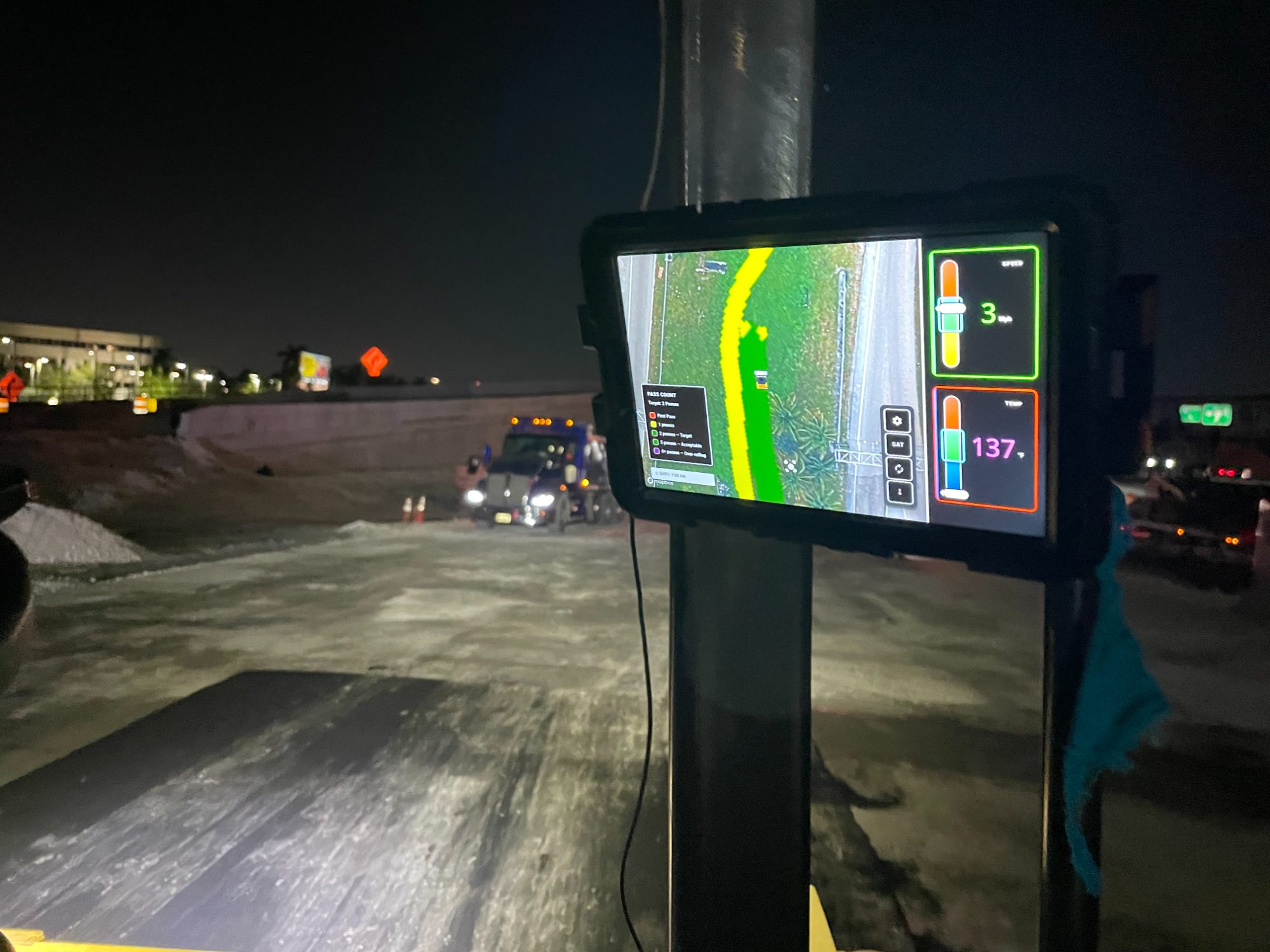
Compactica retrofits your existing rollers into Intelligent Compaction machines in hours. Instead of two dots, you get the whole mat:
- Every pass on every lift, documented in real time.
- Live heat maps showing pass count and coverage while the mat is still hot, Green = Done, so the operator stops guessing.
- Calibration that shows when rolling hits diminishing returns, before you over-roll.
- A GPS- and time-stamped audit trail that holds up when the dispute comes.
A Compactica report is not just QA. It is the proof you reach for when someone questions the work.
why this matters: penalties, rework, and trust
- Penalties. One failed density test can wipe out a day's profit. You are running blind on 99% of the mat and finding out weeks later.
- Rework. Grind-outs and re-paving cost schedule and reputation. Catch the cold load on the third truck while you can still adjust the pattern, not after the lot fails.
- Visibility. Cores and nuclear gauges test under 1% of the mat. Compactica monitors 100%, in real time, in front of the operator.
- Safety. Nuclear gauges put a radiation source and a tech on the mat behind moving equipment. Full-coverage IC data takes both off the road.
the unit price adjustment for density.
Maximize it, and you stop leaving money on the mat. Miss the window, and you are just writing down what it cost you. The difference between those two outcomes is whether the information reached the operator while the mat was still workable.
built to slot into what you already run
Compactica does not replace your QC program or your systems of record. It feeds them better data. The reports are AASHTO R-111-22 compliant, so QA/QC and project closeout stay clean and defensible.
see it for yourself
Want to know what a defensible compaction record actually looks like? Put a sample Compactica report next to a traditional one, and book a live walkthrough with our engineers.
Because on a spec job it was never about passing two tests. It is about proving the whole mat (the first time) so the dispute never has a foothold.
references
- Federal Highway Administration (FHWA). Intelligent Compaction: A Practical Guide for Asphalt Pavements (FHWA-HIF-19-050).
- AASHTO. R 111-22: Standard Practice for Intelligent Compaction Technology for Asphalt Mixtures.
- Asphalt Institute. MS-22: Construction of Hot Mix Asphalt Pavements.
- NAPA. Best Practices for Intelligent Compaction.