
verification explains the outcome. execution is the only chance to change it.
Your QA program is good at one thing: telling you what happened. Density cores, nuclear gauge readings, IC maps, closeout reports: they document the work and they hold up in an audit. You need all of it.
But none of it changes the mat. By the time the number lands, the rollers have moved on and the mat is cold. Verification explains the result. It cannot move it.
two different questions
Verification answers questions you ask after the fact:
- Did the pavement meet spec?
- Can you document it and defend it?
- Does the lot hold up when someone challenges it?
Those matter. But they all get asked once the work is largely done.
Execution asks one question, and it has a clock on it: what do you do right now to hit density before the mat cools?
why the timing breaks
Most density data gets reviewed after the section is paved, after the rollers leave, after the mat drops below the temperature where compaction still works. At that point the data is accurate and useless in the same breath. It explains the lot, it can't fix it.
That is not a failure of your QC program. It is a mismatch between when the workflow delivers information and when the crew can still act on it.
On a lot of jobs the pattern looks like this:
- A density problem shows up after paving has already moved down the road.
- The variability gets written down instead of corrected.
- The "lesson learned" gets applied to the next job, not this one.
That only works if the next job looks like this one. It rarely does. Mix temperature, lift thickness, ambient conditions, and truck timing all shift by the hour.
the window is short
You can still influence the outcome only while:
- The rolling pattern can still change.
- Coverage can still be added or redistributed.
- The mat is still in a workable temperature range.
Once that window closes, all you have left is verification.
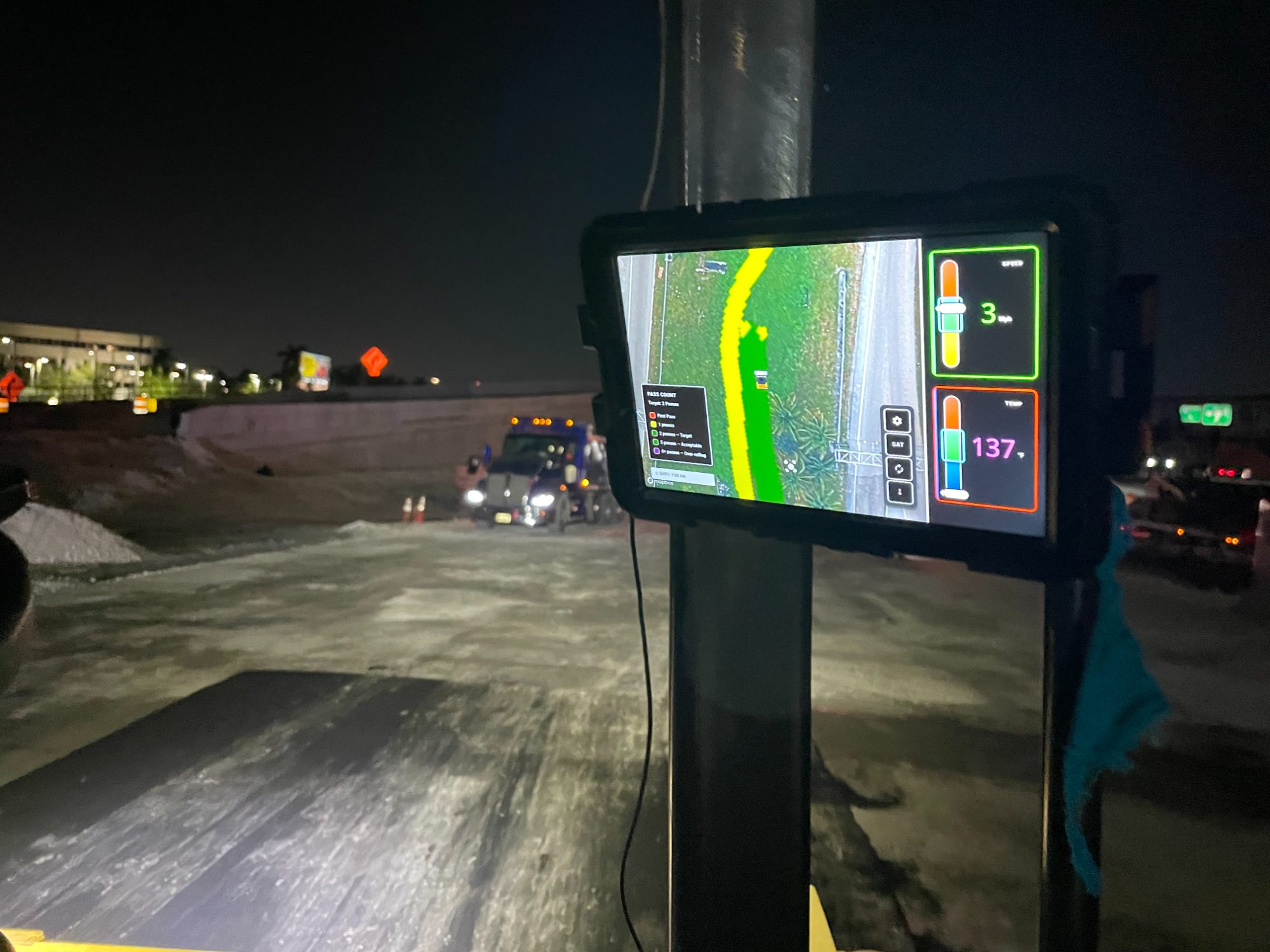
That is the case for real-time guidance in front of the operator. Green = Done means the operator sees coverage as it happens and adjusts on the pass that matters, not in a report next week. Catch the cold load on the third truck while you can still roll it, and you protect the Unit Price Adjustment for density instead of writing down what it cost you.
execution controls the outcome. verification documents it.
Execution and verification are not competing. You need both. They just do different jobs. Confuse the two and you build a program that is excellent at explaining variability and weak at preventing it.
So ask yourself one thing: how much of your current compaction workflow is built to change the outcome, and how much just records it after the mat is cold?
references
- FHWA. Guide to Quality Assurance Procedures for Construction.
- AASHTO. R 111-22: Standard Practice for Intelligent Compaction Technology for Asphalt Mixtures.
- NCHRP Report 676. Quality Control/Quality Assurance Practices for Pavement Construction.
- Asphalt Institute. The Role of Quality Control in Asphalt Pavement Construction.