

Most contractors I talk to are leaving six figures on the table every year. Penalties they could have avoided, and bonus they never maximized. And they never even see it.
That last part is the problem. Nobody sends you a bill for the bonus you didn't capture, so the leak stays invisible. It runs for years.
I want to show you where that money is going, and give you a simple way to put it back on your bottom line.
passing is not the same as capturing
Here is what most people miss about bonus. Pay factor is not pass or fail. It is a dial.
In a bonus state, your density can land you anywhere from a penalty, to break-even, to full bonus, and everything in between. So you can pass every lot, hit the spec, feel good about the job, and still be sitting at three-quarters of the bonus you could have earned. You did not fail. You just left the dial turned down.
The money you are losing is not on the lots you fail. It is hiding in the ones you pass.
run the four numbers
Let me put a number on it. There are four things, and you can do this on the back of a napkin. Use your own figures, because the whole point is that your number, not mine, is the one that gets your attention.
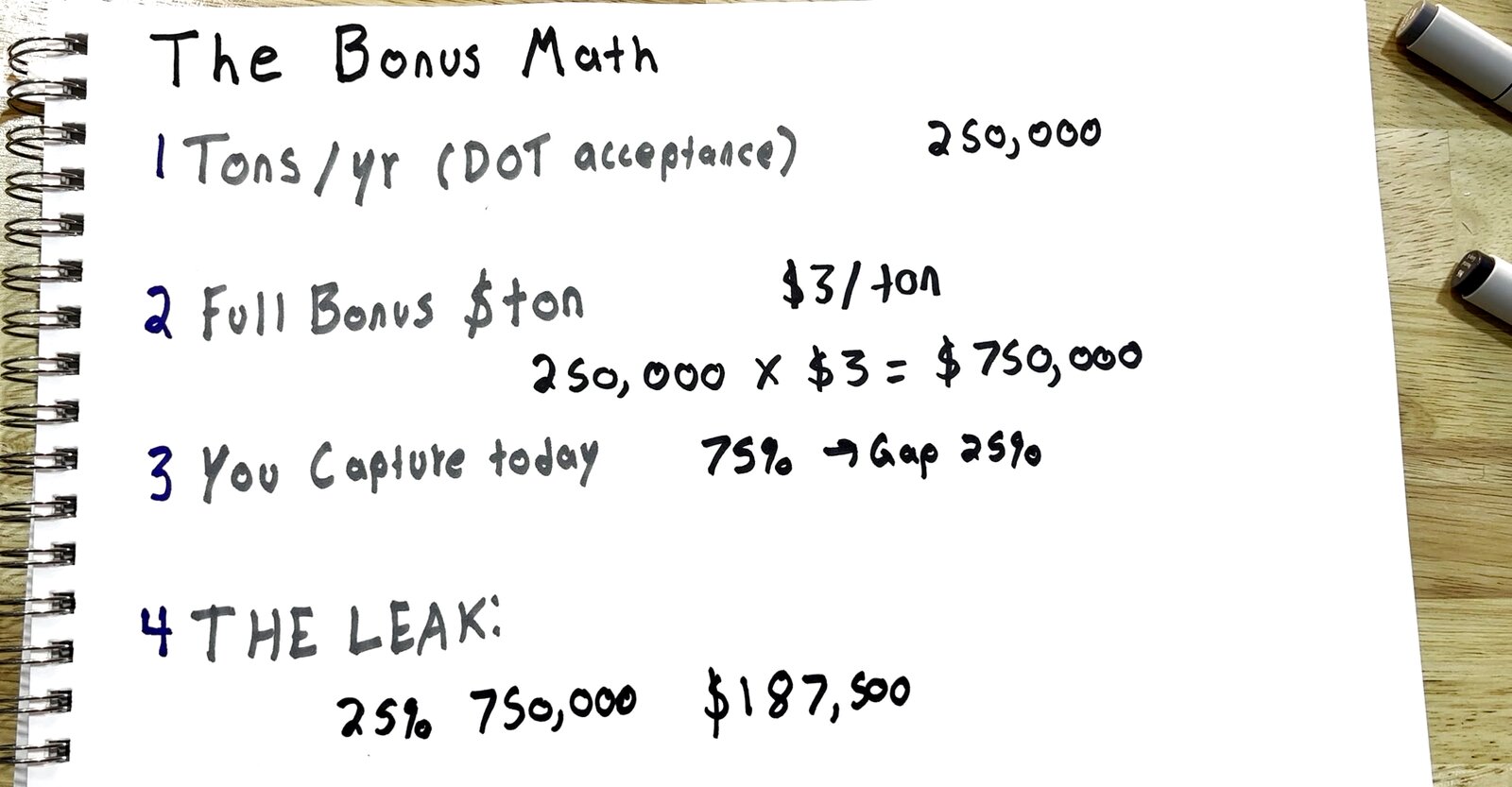
One: how many tons do you lay a year under DOT acceptance? The bonus-eligible work. Say 250,000 tons.
Two: what is full bonus worth per ton? It depends on your state and your mix. Be conservative and call it three dollars a ton. That is the average bonus you would earn per ton if you captured all of it.
So 250,000 tons times three dollars is $750,000 in potential bonus a season. That is your ceiling. And that is just the bonus side. Every penalized lot is the same leak running the other direction, so for a lot of operations this is closer to the floor than the ceiling.
Three: what are you actually capturing? Be honest. Most operations I see are at 75, maybe 80 percent. Not because the crews are bad, but because they are inconsistent. One shift in seven slips.
Four: the leak. Twenty-five percent of $750,000 is $187,500. Left on the table. Every season. On work you already did, with crews you already paid, on tons you already laid.
Go run that with your own numbers. I'll bet it comes out to six figures.
where the money leaks from
So where does it leak? This is how I think about every job, and it is the picture I come back to in every one of these.
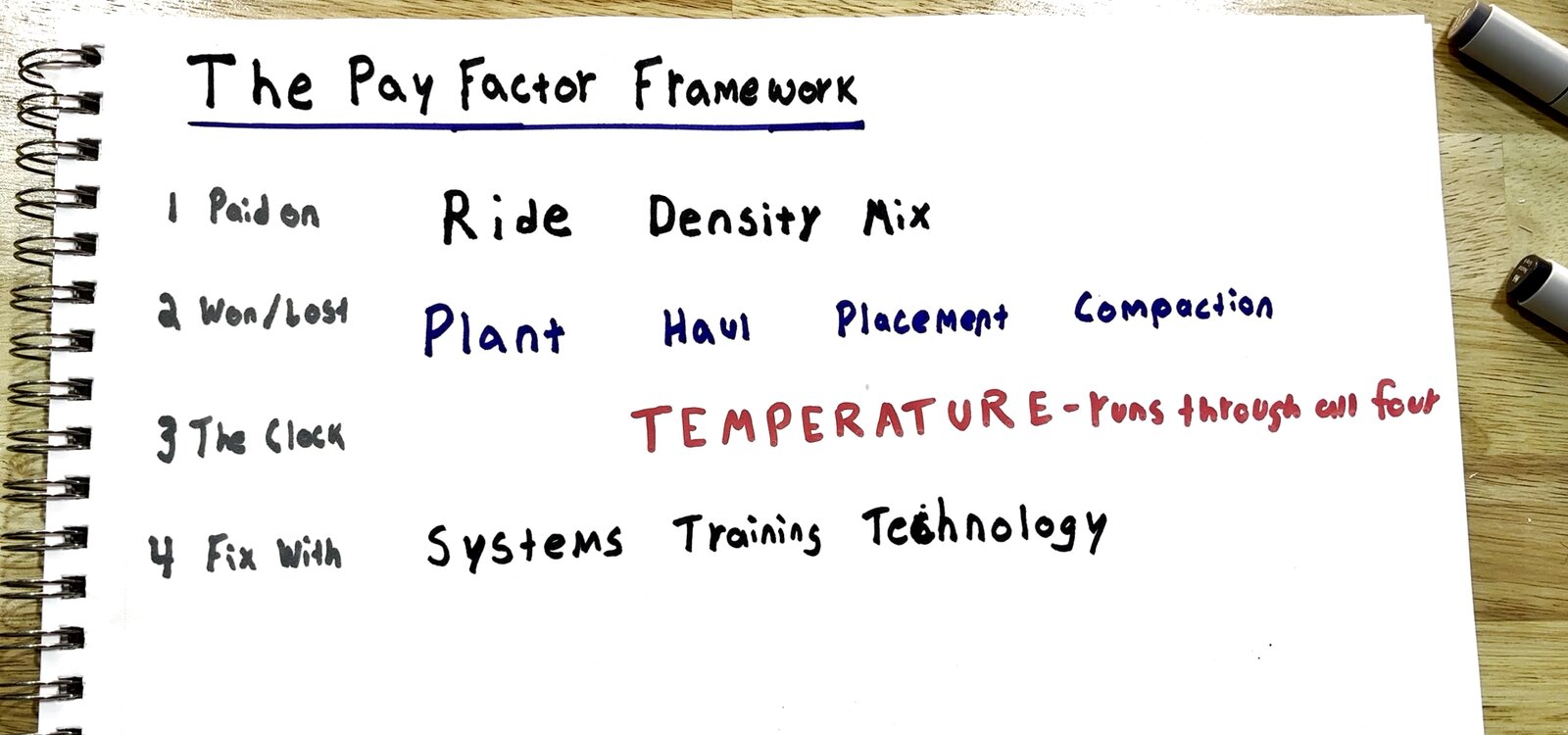
There are three things the DOT actually pays you on: ride, density, and mix.
There are four places where you win or lose them, in the order the asphalt moves: plant, haul, placement, and compaction.
And there is one thing running underneath all of it, always working against you: temperature. The clock.
Every bonus dollar you lose, you lose at one of those four spots. Cold mix out of the plant. A truck that sat too long. A bad joint at placement. And the big one for density, compaction, where the roller pattern that was dialed on Monday has drifted by Thursday. That is the one shift in seven.
you fix all of it with three things.
Better systems, better-trained people, and technology that catches the slip while the mat is still workable instead of in a report three weeks later. That framework, three scores, four controls, three fixes, is the spine of everything that follows.
why the leak stays invisible
Now the honest part, and it is the real reason this money disappears quietly. Most contractors have no way to see where the leak is happening, shift to shift.
You find out a lot got penalized weeks later, when the cores come back, long after the crew has gone home and the mat is cold. Unless you are running intelligent compaction, you do not have the data at all. That is the whole problem. You cannot fix what you cannot see until it is already too late.
So I am not going to tell you to go pull a pile of data you do not have. Instead, two pieces of homework.
One: calculate your missed bonus. Run those four numbers with your real tonnage. Get the actual figure.
Two: think about your misses. When you do not hit your max bonus, what are you hearing out on the job? Is it trucking, with loads showing up cold or late? Is it the plant, with mix running hot, cold, or out of spec? Or is it compaction, with the rolling pattern drifting from one shift to the next? Maybe you are not sure. Maybe it is all three. That is completely fine. That is exactly the point.
Over the next few posts I am going to break down every one of these. Each piece of the framework, why it is costing you bonus, and how to use it to start maximizing your pay factor. And I will show you how you can finally get answers every shift, and catch these problems before they turn into a penalty.
the density bonus playbook runs the math for you.
Same four numbers, your own tonnage, about five minutes. It is the fastest way to see what your leak is actually worth. Get the free Density Bonus Playbook →
Next up, I start breaking down the framework one piece at a time, beginning with the biggest one for density: compaction.
references
- Asphalt Institute. MS-22: Construction of Hot Mix Asphalt Pavements.
- Federal Highway Administration (FHWA). Intelligent Compaction: A Practical Guide for Asphalt Pavements (FHWA-HIF-19-050).
- National Asphalt Pavement Association (NAPA). Density Bonus and Pay-Factor Specifications: An Overview.
- AASHTO. R 111-22: Standard Practice for Intelligent Compaction Technology for Asphalt Mixtures.